CuW75 / CuW70
Threaded Electrodes
Precision-threaded welding consumables
Both grades available · MOQ: None for standard sizes · Lead time: 10–14 days standard · 20–25 days custom
Overview
Made by infiltration, finished by machining
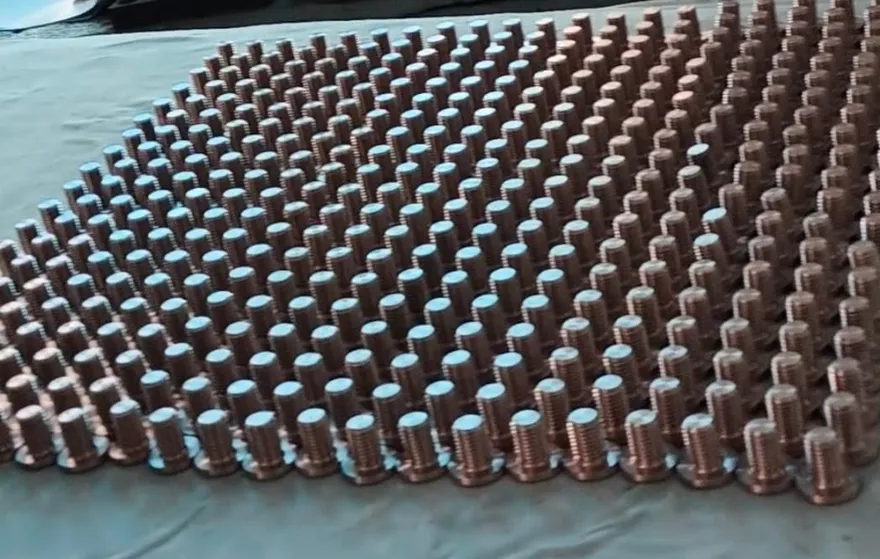
Threaded tungsten-copper electrodes for resistance-welding guns and automated stations — machined in-house on 15 lathes with thread gauges verified per batch.
Standard and custom thread forms to your drawing; batches shipped with dimensional inspection records.
Material values shown are typical for the grade. Per-batch composition, density and hardness reports are provided on request — see quality control.
| Grades | W/Cu 75/25 · W/Cu 70/30 |
| Thread forms | Metric · UNC/UNF · to drawing |
| Lead time | 10–14 days standard · 20–25 days custom |
| MOQ | None for standard sizes |
Typical applications
- Resistance-welding guns
- Automated welding stations
- Robot torch consumables
In depth
Engineering notes
Threading a refractory composite
Cutting a clean thread in tungsten copper is a quality-control problem more than a machining one: the copper phase tears easily, and a torn thread root becomes a stress riser exactly where gun vibration concentrates. Our thread cell runs fifteen lathes dedicated to this work, with go/no-go thread gauges checked per batch — because a thread that gauges true on arrival is the only thread that screws into your gun the first time.
Metric and UNC/UNF forms are routine; special forms, left-hand threads and tapered shanks are cut to drawing. Dimensional inspection records accompany each batch on request.
Design notes for gun integration
The threaded joint in a welding gun does three jobs at once: it carries welding current, it holds electrode force, and it must release for tip changes without galling. Thread fit class matters here — we cut to the class your holder was designed around, and we can hold it batch after batch because the same lathe programs run every order.
For automated stations, consistency beats everything: an electrode that seats identically every time is one that does not force a re-teach of your robot cell. Repeat orders are machined to the same program and the same drawing revision, so seating behavior never drifts.
Failure modes worth knowing
Threaded W/Cu electrodes rarely fail at the thread; they fail at the face, from mushrooming and coating pickup — the same wear physics as every resistance-welding consumable. What threads do fail from is cross-threading at tip changes and vibration loosening in guns without the right seating torque.
If your consumption pattern shows thread damage rather than face wear, the fix is usually seating practice or holder design, not alloy. Send us the failed electrodes — a photo of the wear face tells us more than a purchase order does.
Technical library
Further reading
The guides engineers read before they write the second drawing.
- Specifying threaded tungsten copper electrodes Thread callouts, shoulder geometry and torque values for gun-mounted electrodes.
- Machining tungsten copper: threads and holes Tap selection, coolant and the thread failure modes worth designing out.
- Resistance welding electrode alloys compared CrZr, BeCu and W/Cu side by side — where each one actually earns its place.
- RWMA electrode classes explained What the class system tells you about a W/Cu electrode, and what it does not.
Also from the same floor
Pair it with
 Best seller
CuW75 · 75% Tungsten
W/Cu 75/25 Electrode Wheels
The workhorse alloy for seam-welding wheels
View specs
 High conductivity
CuW70 · 70% Tungsten
W/Cu 70/30 Electrode Wheels
Higher conductivity for heavy-current welding
View specs
 Stock shapes
CuW75 / CuW70
Electrode Rods & Blocks
Stock shapes machined from infiltration bar
View specs
Need Threaded on a drawing?
Send alloy, dimensions and quantity — quote back within 24 hours.